
Introduction
Today, WiFi is part of everyday life. We use it to browse the internet, stream movies, attend meetings, and control smart home devices. But very few people actually know how this technology started or who invented WiFi.
The truth is, WiFi was not invented by a single person. It is the result of decades of research in wireless communication, radio signals, and networking technology. Many scientists and engineers contributed to what we now call WiFi.
In this guide from Smart Home Fix (Fixing Homes, Enhancing Lives), you will learn the full story behind WiFi, including its origin, key innovators, and how it became the backbone of modern digital life.
What is WiFi?
WiFi is a wireless technology that allows devices like phones, laptops, and smart TVs to connect to the internet without cables. It uses radio waves to transmit data between your device and a router connected to the internet.
In simple words, WiFi replaces physical cables with invisible signals, making internet access faster and more flexible.
Quick Summary
- WiFi was not invented by one person
- It was developed through multiple scientific breakthroughs
- Key contributions came from IEEE 802.11 standards
- A team at CSIRO (Australia) made major breakthroughs in WiFi technology
- WiFi became widely available in the late 1990s
Who Invented WiFi? The Real Answer
If you are searching who invented WiFi, the most accurate answer is:
WiFi was developed by a group of engineers and scientists, not a single inventor.
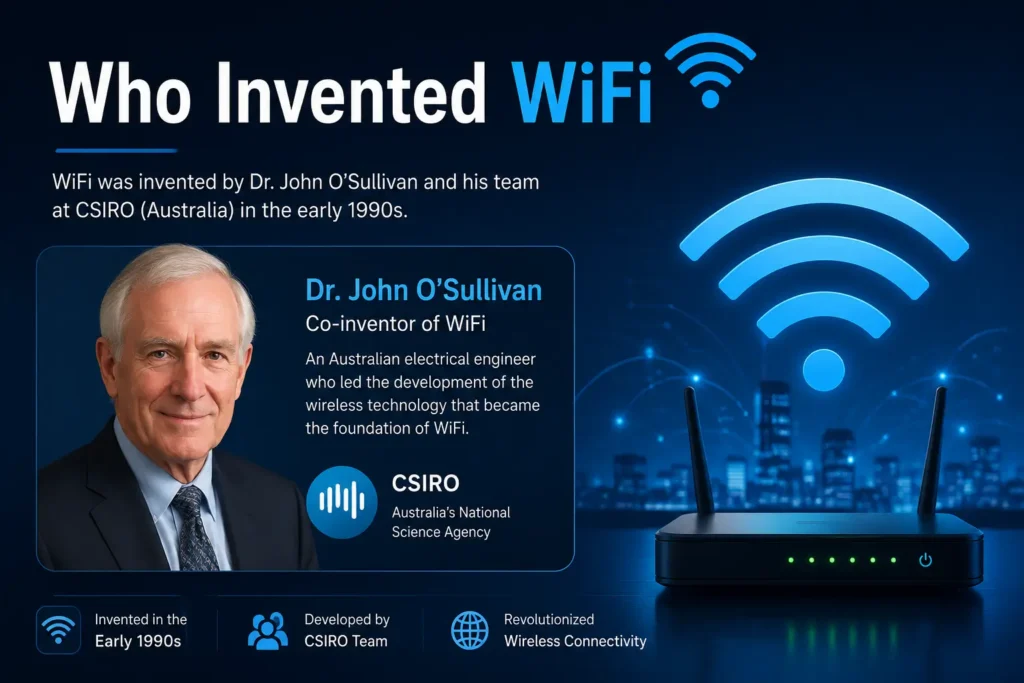
However, one of the most important breakthroughs came from a team at Australia’s national science agency, CSIRO, led by Dr. John O’Sullivan.
Key Contributor: Dr. John O’Sullivan
Dr. John O’Sullivan and his team worked on radio astronomy research in the 1990s. Their work helped solve a major problem: how to reduce signal interference in wireless communication.
This breakthrough became a core technology behind modern WiFi systems.
Important Note
While CSIRO contributed key technology, WiFi also depends on global standards developed by the IEEE organization.
So, when asking who invented WiFi, it is more correct to say:
WiFi is a global invention built by multiple innovators over time.
The Early History of WiFi Technology
To understand who invented WiFi, we need to go back to early wireless communication.
Early Radio Waves (1800s–1900s)
Scientists like Heinrich Hertz and Guglielmo Marconi discovered that signals could travel through air using radio waves.
This was the foundation of all wireless technology.
Military and Academic Research (1940s–1980s)
During this time, wireless communication was used in military systems. Later, universities began experimenting with data transmission without wires.
Birth of IEEE 802.11 (1997)
The real standard for WiFi, called IEEE 802.11, was introduced in 1997. This allowed devices from different companies to communicate using the same wireless rules.
Without this standard, WiFi would not work universally.
Key Innovators Behind WiFi
Even though people often ask who invented WiFi, the truth includes multiple contributors.
CSIRO Team (Australia)
They developed technology to reduce signal interference, making WiFi stable and fast.
IEEE Engineers (Global)
They created the official WiFi standards that ensure global compatibility.
Tech Companies (Late 1990s–2000s)
Companies like Apple, Intel, and Cisco helped bring WiFi into homes and businesses.
How WiFi Works
WiFi works using radio waves. Here’s a simple breakdown:
- Your device sends data to a router
- The router converts it into radio signals
- Signals travel through the air
- The internet receives the request
- Data returns back to your device
This happens in milliseconds.
So when you ask who invented WiFi, remember that the invention includes both hardware and communication standards.
WiFi Timeline (Important Milestones)
| Year | Event |
| 1890s | Radio waves discovered |
| 1970s | Early wireless data experiments |
| 1997 | IEEE 802.11 standard released |
| 1999 | WiFi becomes commercially available |
| 2000s | WiFi expands into homes and smartphones |
This timeline shows that who invented WiFi is not a single moment, but a long evolution.
Why WiFi Was a Breakthrough
WiFi changed the world in many ways:
- No need for cables
- Faster communication
- Enabled smartphones and smart homes
- Made remote work possible
- Supported IoT (Internet of Things)
Without WiFi, modern digital life would not exist as we know it.
WiFi in Smart Homes (Real Example)
In a modern US home, WiFi connects:
- Smart thermostats
- Security cameras
- Voice assistants like Alexa
- Smart lighting systems
This is why Smart Home Fix focuses on explaining technologies like WiFi—because they power today’s homes.
So when people ask who invented WiFi, they are also indirectly asking how smart homes became possible.
Common Misunderstanding About WiFi Inventor
Many websites incorrectly say WiFi was invented by one person or company. This is not true.
The reality is:
- No single inventor exists
- It is a combination of science + engineering + global collaboration
- CSIRO holds important patents, but not the entire invention
So the correct answer to who invented WiFi is always shared credit.
Future of WiFi Technology
WiFi continues to evolve:
- WiFi 6 and WiFi 7 offer faster speeds
- Lower latency for gaming and streaming
- Better smart home performance
- Improved device connectivity
The invention is still growing, not finished.
Frequently Asked Questions
Who invented WiFi in simple words?
WiFi was not invented by one person. It was developed by scientists and engineers worldwide, including major contributions from CSIRO researchers and IEEE engineers.
Further details show it evolved through decades of research in wireless communication and networking standards.
Was WiFi invented by one company?
No, WiFi was not created by a single company. It was developed through global collaboration, including research institutions and technology companies working together on standards and hardware.
This teamwork made WiFi compatible across all modern devices.
When was WiFi first used?
WiFi became commercially available in 1999 after the IEEE 802.11 standard was released in 1997. It quickly became popular in homes, offices, and public places worldwide.
What is CSIRO’s role in WiFi?
CSIRO researchers developed important technology that reduced signal interference, which helped make WiFi faster and more reliable. Their work is a key part of modern wireless systems.
Why is WiFi important today?
WiFi is essential because it connects billions of devices without wires. It supports communication, entertainment, education, and smart home systems across the world.
Conclusion
If you understand who invented WiFi, you also understand how modern life became wireless. From homes to workplaces, WiFi has become the invisible backbone of connectivity. Keep exploring Smart Home Fix, how it continues to evolve for smarter living.